Trace the Evidence Behind a Public Claim
Trace the evidence chain behind a public claim to see what its source supports, where interpretation begins and what remains uncertain before you share it.
A council notice can confirm that a proposal was announced, but it cannot by itself explain why a bus route later changed. The evidence chain behind a public claim is easier to assess when you identify what each document or account can actually establish—and where the argument moves beyond it.
Think of the process like following a paper trail for a household repair: a landlord’s note, a plumber’s report and a neighbour’s explanation may all matter, but each answers a different question. The useful task is not simply to rank sources; it is to see how a claim is assembled from them.
Map how the claim was assembled
Public stories often combine distinct elements: an event, a record of that event, an explanation of its cause and a judgement about its significance. Those elements can become hard to tell apart once they are compressed into a headline or a short post.
Write down the claim in a form that could be checked, then divide it into its component parts. “The rule is failing” might mean that the rule took effect, that a particular outcome followed, or that the rule caused the outcome. Each part calls for different support.
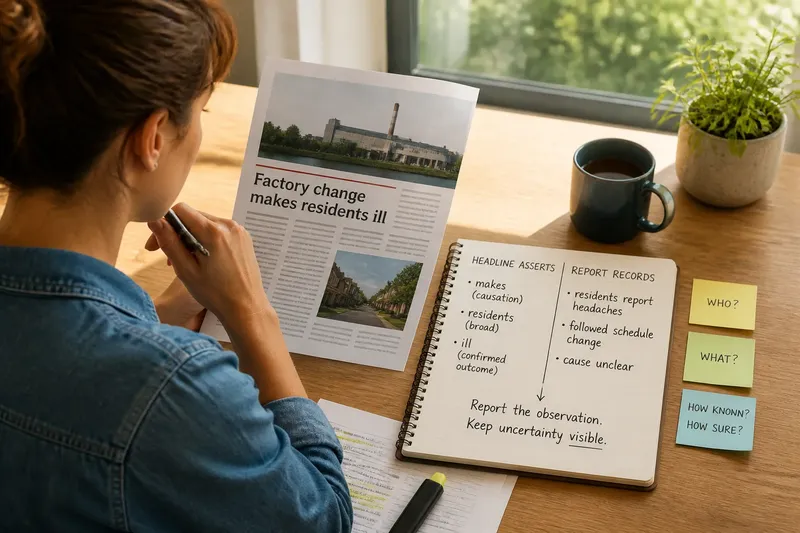
Pay attention to the verbs. “Announced”, “recorded”, “increased” and “caused” make different commitments. A council notice may establish that a change was announced; it does not establish that the change produced a later result.
Trace how meaning changes between sources
Follow the claim back through the story’s links and attributions. A news report may point to a meeting record, agency notice, court filing, public report or recorded interview. That material may be the closest available source, but it can also rely on earlier records or other people’s accounts.
Compare the wording at each stage. Ask whether a later account has changed the scope, certainty or subject of the original statement. “Some residents spoke against the proposal” can become “residents oppose the proposal” when a limited account is retold as a broader verdict.
For each link, note who is speaking and what they are in a position to know. A spokesperson can establish what an organisation says it plans to do; a published notice can establish what it formally announced. Neither necessarily answers what happened afterwards.
Check the argument connecting evidence to conclusion
Evidence does not always speak for itself. A source may document an observation, while the claim built from it depends on a comparison, an assumption about cause or a rule for interpreting what happened. Make that connecting argument visible before deciding whether it holds.
Say you read that meeting minutes record several objections to a proposed bus change. The minutes support the statement that people objected at that meeting. To conclude that most residents oppose the change, you would need a basis for extending that observation beyond those who attended.
This distinction also helps when you agree with the conclusion. You can explain what the source establishes and what reasoning carries the argument further, instead of presenting an interpretation as if it were directly recorded.
Use a decision list to identify what is missing
For each part of a claim, record an observable feature and decide what to do if it is present or absent. The list is a way to choose your next step, not a score for declaring a story true or false.
- Exact wording: Check whether the source states the same claim. If it does, assess that wording; if it does not, narrow your description to what it actually says.
- Source attribution: Check whether the report names and links its source. If it does, follow the link; if it does not, search the quoted phrase with the organisation’s name or mark the source as unlocated.
- Scope: Check whether the source covers the place, group or period named in the claim. If it does, retain that scope; if it does not, limit the claim to the coverage shown or seek a source that matches it.
- Definitions: Check how key terms are defined in the relevant passage. If the definition matches the claim, keep the wording; if it differs or is absent, describe the narrower documented meaning or leave the point unresolved.
- Supporting material: Check whether the cited document, record or observation is available to inspect. If it is, examine the relevant section; if it is not, distinguish an assertion that evidence exists from evidence you can assess.
- Reasoning: Check what comparison or explanation connects the material to the conclusion. If the link is given, assess whether it fits; if it is missing, describe the conclusion as an interpretation and identify what would clarify it.
- Changed wording: Check whether later retellings strengthen, broaden or alter the original claim. If they preserve its meaning, report it accurately; if they do not, return to the narrower source wording or explain the shift.
Work through a claim without filling the gaps
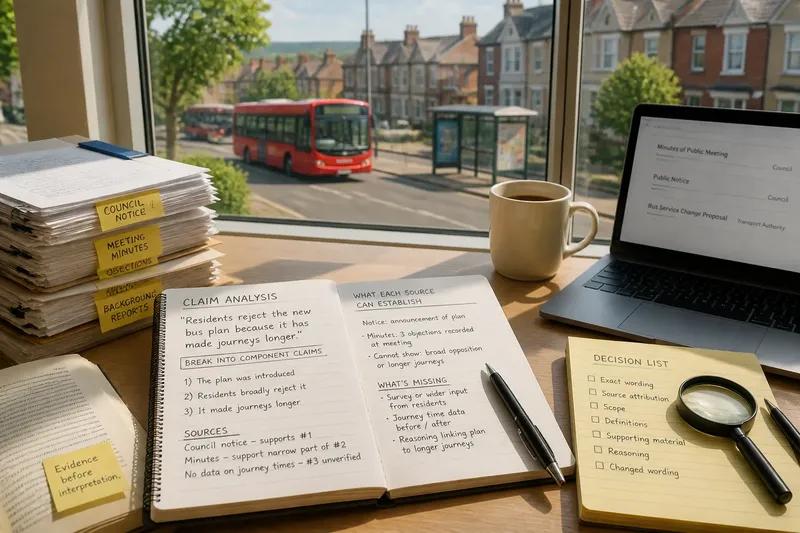
Imagine a local news post says, “Residents reject the new bus plan because it has made journeys longer.” You have a council notice announcing the plan and minutes recording three objections at a public meeting; neither document contains a survey of residents or a comparison of journey times before and after the change.
First, split the post into three claims: the plan was introduced, residents broadly reject it, and it made journeys longer. The notice supports the announcement, while the minutes support the narrower point that three objections were recorded at that meeting.
Next, check what each source cannot establish. The minutes do not show how residents who missed the meeting feel, and the notice does not compare journey times. The resulting account is therefore: “The council announced the plan, and three objections were recorded at a meeting; these documents do not establish broad opposition or longer journeys.” That wording preserves the supported details without pretending the remaining questions have been answered.
Questions that help assess a public claim?
What counts as the closest available source?
It is the source nearest to the statement or material being examined, such as a signed notice, complete recording or original report. “Closest” is relative: a report may present its own findings while relying on interviews or records that are closer to a particular event.
Can a news story support any part of a claim?
Yes: it can establish what that publication reported or quoted. For claims about the event behind the story, follow the attribution where possible and keep the journalist’s account distinct from what an underlying document or speaker says.
How should I treat an anonymous source?
Anonymity can protect a person from harm, but it limits a reader’s ability to assess their access and perspective. Check what the publication explains about the source’s basis for knowing, and keep any remaining uncertainty in your description.
What can I say when the evidence is incomplete?
State what the available material supports, then name the part it does not establish. For example: “The notice confirms the proposal was announced; it does not by itself establish that the proposal caused the reported change.”
Keep uncertainty attached to the specific link
New information may affect one part of a story without settling the rest. A corrected date may leave an observation intact, while a source that was misquoted may change what the account supports. Update the affected part rather than treating the whole story as either confirmed or disproved.
When you trace the evidence chain behind a public claim, you can say more precisely what the source establishes, what argument connects it to a conclusion and what remains open. That precision makes it easier to revise your view when a missing document or clearer account becomes available.